Which Hold Is Missing?
Five years of Thai month names that would not stick, a body-peg mnemonic glued together in a hospital cafe, and the discovery that the wall had grooves in it all along. A diagnostic for the moment a word refuses to hold.
Dengue is a bitch, I thought.
I was waiting. Waiting and waiting for my latest blood test results to come back.
While I sat in the cafe out the front of the Thai hospital in Trat I decided to fill in my time by doing something constructive: Thai language study. I wanted to remember the names of the Thai months but for the life of me, I couldn’t remember them.
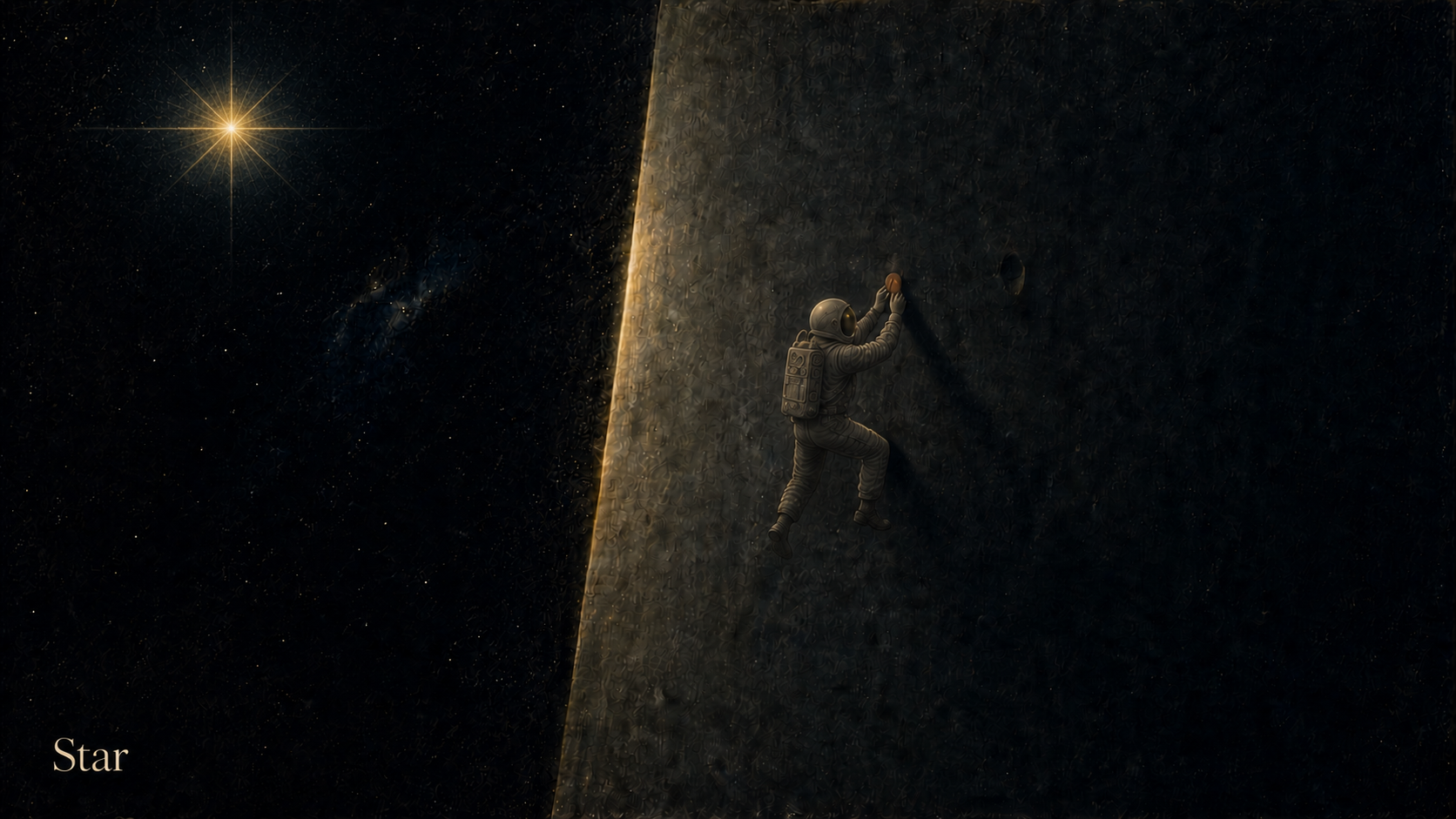
They felt arbitrary: a smooth wall with no handholds.
This resonates with Hattie and Yates (2014), who noted that
New information, which cannot be related to existing knowledge, is quickly shed.
The Thai months kept falling off that wall, and had for the last five years of learning Thai.
There was nothing to hold onto: no links in English, no links in Thai (they are Sanskrit words, kind of the Latin of South East Asian languages). Like what I did there? I just gave you a hold for Sanskrit.
So, in that hospital cafe and mind foggy with post-dengue symptoms I decided to make my own holds and glue them to the smooth wall.
A synthetic hold if you will.
I used the body-peg method. A mnemonic technique where you memorise an ordered list by mentally “hanging” each item on a fixed body part (head, nose, shoulders, chest, hands, knees, feet), then recalling the list by walking down your body in the same order.
That’s what I did. For example, กันยายน kan-yaa-yon, or September, I placed on my kneecap. I linked gan-yaa to gunjaa and my potato head knee became a marijuana-smoking pothead.
And you know what? It worked, but it also seemed to confirm that the words had no natural structure to anchor meaning to.
So, I glued that synthetic hold on the wall for September and one month after another I climbed that insurmountable memory problem. But was there an easier way?
Which hold is missing?
As a language learner, or a teacher of a second language, when a concept or new word doesn’t stick it’s useful to ask which hold is missing.
- Is it connecting to a concept, experience, action, or meaning the learner already knows?
- Is it uncovering a structure already present in the language?
- Or is it supplying a temporary mnemonic when neither route is enough?
Your job as a teacher or student is to see the existing holds on the wall, the steps between the holds, and the places where you need to add your own.
Carl Hendrick (2026) describes the same thing as a weave:
We grasp a new thing only by fastening it to things we already hold: the richer the existing weave, the more points at which a new thread can catch.
The holds were there all along
When researching for this article I decided to look a little bit deeper into the etymology of the months in Thai.
And the wall wasn’t as smooth as I first thought.
The Thai month names are based on the twelve zodiac signs used in Indian astrology. And the final suffix of each month relates to how many days that month has. For example, าคม (-aa-khom), from Sanskrit āgama, is used for 31-day months. ายน (-aa-yon), from Sanskrit āyana, is used for 30-day months.
So, my pot-headed friend: in Sanskrit, kanyā means a maiden or young woman, representing Virgo. Literally, “the arrival of the maiden sign.”
The holds were there all along.
The months had not been completely smooth after all. I had been running my hands over them without noticing the groove.
The concepts already existed. What was missing was a route from the new word to the knowledge I already held.
The principle that new knowledge builds on prior knowledge still applies in a second language. Or as Kevin Horsley (2014) puts it in Unlimited Memory:
We learn only by association. Learning connects new information to old information; it doesn’t happen any other way. … The more you know, the easier it is to connect more information, and to know even more.
The difference, in second language learning, is that much of the learner’s prior knowledge may currently be organised through another language.
Temporary holds
But sometimes that is still not enough and we need a temporary hold, like me using the body peg before realising I had more to hold onto than I thought.
For example, at my school we use the Jolly Phonics system to help young readers internalise the connections between sounds and the written word. This works, even though it’s synthetic, because the mnemonics (actions, pictures, chants and stories) create a graded climbing route for young readers. These things don’t replace the relationship between letters and sounds. They supply a temporary retrieval route until the child is ready to climb, and read, without the extra holds.
The unnecessary holds
If the mnemonic disappears you might ask why build it in the first place.
Scott Young (2023) sees mnemonics as vivid imagery that
acts as a bridge between two concepts that would otherwise be difficult to associate. … However, if you practice enough, the two ideas get directly associated—with no intervening imagery.
What about synthetic phonics? No amount of reading alone, particularly in a second language context, is going to make you a competent reader.
The bridge, or temporary hold, is therefore worthwhile when it allows a connection to be made which otherwise would never happen, or would have taken too long to happen. (You hear that, Krashen? Input ain’t everything.)
So as a teacher you should prefer a found hold where one exists, but build a peg when the alternative is repeated failure. Hello, Thai months.
A synthetic hook or hold is a scaffold, not a home. Its disappearance is evidence that it did its job.
The missing hold diagnostic
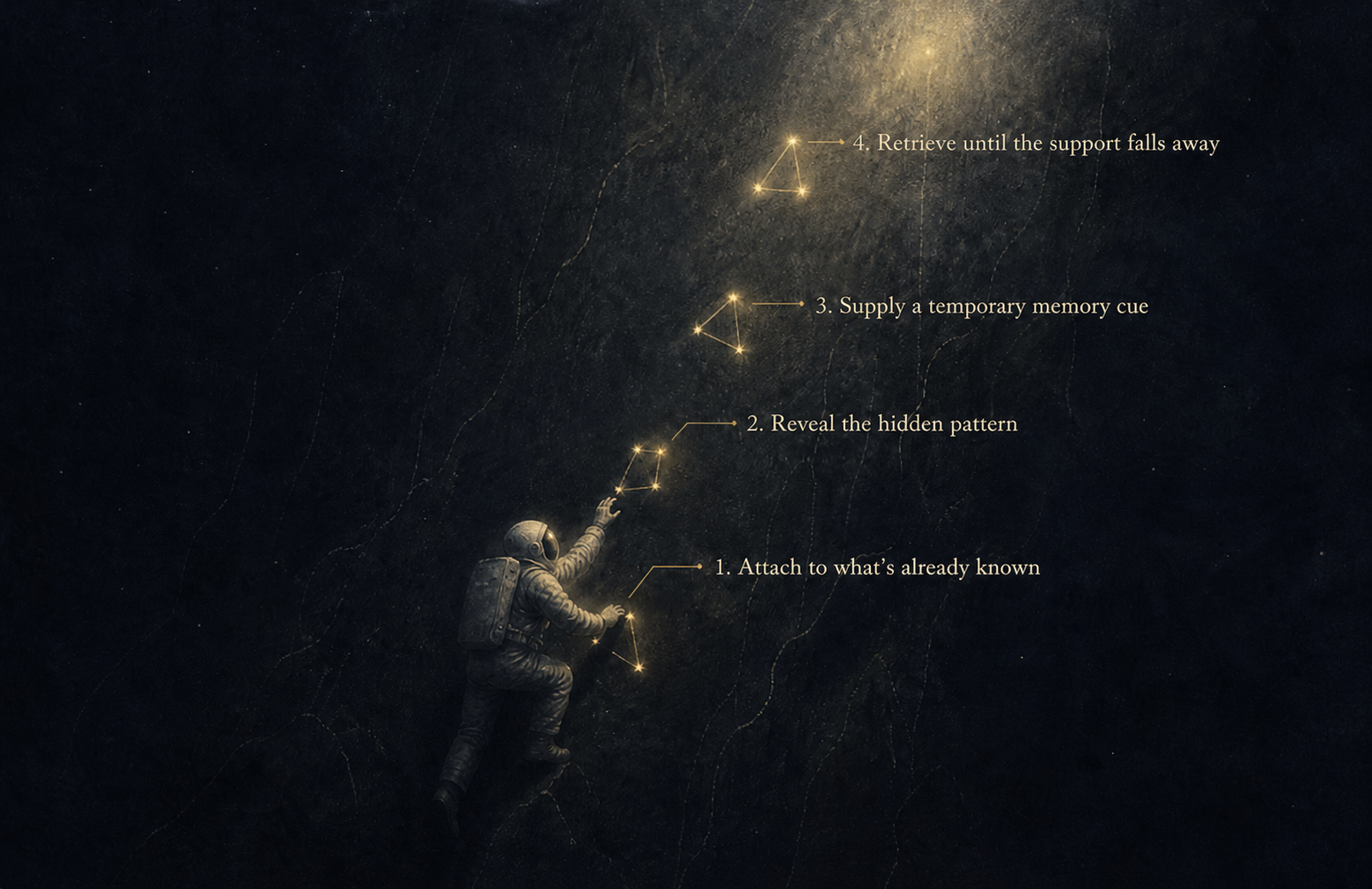
Ploy, 11, hits disaster in a reading text. Long word, abstract meaning, nothing sticks. Run the diagnostic.
1. What existing concept, experience, or familiar word can this form attach to?
The concept is already there. Every Thai kid knows น้ำท่วม (nam-tuam, flood) and สึนามิ (su-naa-mi, tsunami). 2004 is still in the national memory, and tsunami is already a loanword she uses. She has seen ภัยพิบัติ (phai-phi-bat, disaster) on the news. Only the English form is new. Attach it to a real memory: the year the school car park went underwater, or the tsunami stories from Phuket.
2. What real pattern is currently hidden?
Disaster = dis- (bad) + aster (star). Literally “bad star”, from the old belief that catastrophes were written in the stars. Bonus: the pattern unlocks asteroid, astronaut and asterisk for free.
3. If neither is enough, what temporary mnemonic, gesture, or physical cue can I supply?
Make the bad star ridiculous. Not a falling star, an evil one. A giant angry star with sunglasses and a villain moustache screams down from space, cannonballs into the sea, and the splash floods the whole school. Teachers float past on desks. The star surfaces and cackles. Bad star equals disaster. The dumber the image, the longer it lasts. Add the gesture: trace the star falling, crash it into the desk.
Or use the keyword method: find a Thai word that sounds like part of the target word, then fuse the two in one image. Disaster starts with ดิสโก้ (disco) and ends with a sound like ตา (taa, grandpa). Disco grandpa. Image: Grandpa hits the disco floor at the wedding, spins too hard, crashes into the speaker stack, and the cake goes down with him. Disco taa equals disaster. The sound-alike carries the form; the image carries the meaning.
4. What retrieval will make that support unnecessary?
Spaced use, not spaced rereading. Next lesson: “Describe a very bad event in Thailand.” A week later: “The flood was a real ___.” Then have her spot the aster family in new texts. When she says disaster without seeing the moustachioed star or disco grandpa, the peg has done its job and can fall away.
Looking for the hold
My blood results came back and I was dengue-free. I was also free of another thing: my inability to remember the Thai months.
The Thai months were difficult to hold onto not because there wasn’t an existing path, but because I couldn’t see that path. So, in my post-dengue fever dream, temporary ones had to be built.
The job of the teacher or learner of a second language is to route every new concept to a hold the learner already knows, or to briefly create a synthetic hold which can carry the weight of the new idea until the learner can hold it themselves.
References
Hattie, J., & Yates, G. C. R. (2014). Visible learning and the science of how we learn. Routledge. https://www.routledge.com/Visible-Learning-and-the-Science-of-How-We-Learn/Hattie-Yates/p/book/9780415704991
Hendrick, C. (2026). Marble curriculum. Marble. https://withmarble.com/curriculum
Horsley, K. (2014). Unlimited memory: How to use advanced learning strategies to learn faster, remember more and be more productive. TCK Publishing. https://www.tckpublishing.com/our-authors/author-kevin-horsley/
Lloyd, S. (1992). The phonics handbook. Jolly Learning. https://shop.jollylearning.co.uk/products/jolly-phonics-handbook
Young, S. (2023, June 6). Why flashcards beat mnemonics for studying. https://www.scotthyoung.com/blog/2023/06/06/flashcards-vs-mnemonics/
Same constellation