AI Can Write Your Language Textbook. Should You Let It?
With endless material on demand, the solo learner’s challenge is deciding what to practise next.

During COVID, my son took swimming lessons in a pool in a small coastal town. With an instructor, he was confident in the water.
After we returned to Australia, we took him to the Gold Coast. When a wave reached him, he fell back and took my hand. He didn’t want to go in.
I keep coming back to that difference when I think about learning a language by yourself. A textbook is the swimming pool. Teachers and materials writers have chosen the language and put it in order, with editors and publishers helping shape the course. You know where the next lesson is. If you’ve picked a book for self-study, there should be an answer key to check your attempts.
Learning online by yourself is the open sea. There’s enough language there to keep you occupied for a lifetime. Deciding how to spend your time in it is up to you.
For years, I’ve wondered whether the internet could become a virtual textbook. Now that AI can write material around our interests and act as a practice partner, do we still need to buy a conventional textbook?
I’d like to say no. The organisation still bothers me, though. Once you start choosing everything yourself, how do you stop it all becoming scattered? How do you build a balanced week of study around language that interests you?
Kató Lomb gives us somewhere to start.
1970: Beyond the textbook
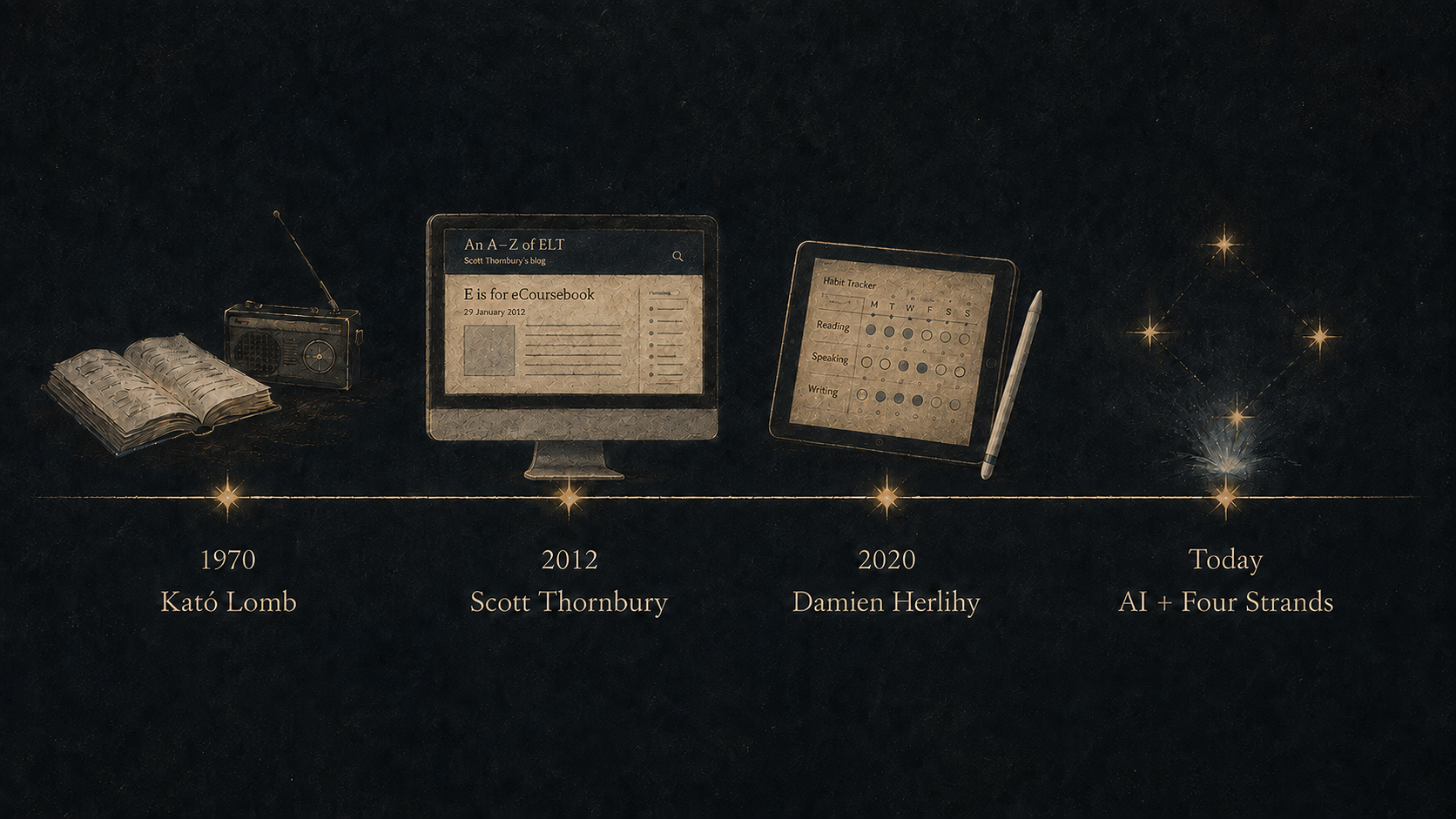
Lomb was a Hungarian interpreter who taught herself languages long before podcasts and downloadable graded readers. In Polyglot: How I Learn Languages, first published in Hungarian in 1970, she describes how she would begin learning a fictional language called Azilian.
She starts with a large bilingual dictionary, exploring familiar-looking words as though she were solving a puzzle. Then she buys a textbook with an answer key.
She attempts the exercises, leaves wide margins and writes the correct answers beside her mistakes. She calls this record “the history of my folly”.
Her study extends well beyond those exercises. She doesn’t wait until she’s ready. She reads novels she only half understands, listens to radio news she’s already heard in a familiar language, and gathers useful words in sentences. Alongside deliberate study, she encounters language because she wants to understand what someone is saying.
Reading Lomb, I had that familiar feeling: are we reinventing the wheel again? So much of the advice I hear from polyglots on YouTube seems to land on the same ideas.
Lomb moves between the pool and the sea. Her textbook gives her organised practice; books, broadcasts and conversations take her into less controlled language. But reaching that wider world takes legwork. She has to track down books, find broadcasts she can follow and seek out people to speak with. Those opportunities don’t arrive through a single screen.
2012: The internet opens the gates
Four decades later, the internet is bringing those possibilities together. What took a search through bookshops or a chance encounter can now begin with a few clicks. The difficulty is shifting from finding material to deciding what deserves your time. In January 2012, as Apple promoted electronic textbooks, Scott Thornbury asked whether language learners needed a coursebook at all.
In E is for eCoursebook, he described learning built around online material, opportunities to use the language and feedback. A video could lead into discussion, work on useful phrases and collaborative writing.
He also considered people working alone. They could find texts, consult dictionaries, review vocabulary, record themselves for feedback and connect with other speakers online. He saw an alternative to the coursebook in tools already available or on the way.
To me, this was the democratisation of what Lomb had been doing. Resources she had to hunt down were becoming easier to reach.
Getting into the open sea was no longer the problem. Learners could now drown in it.
Thornbury’s proposal included activities and support. I kept wondering how a learner would fit those possibilities into an ordinary week without a teacher organising it all.
2020: Showing up regularly
I returned to that question in my Pavilion ELT video on habit tracking, part of a 2020 series about the internet as a virtual textbook.
I focused on consistency. A regular reading habit was my example, and I explored ways to track it, from paper and pen to apps with reminders and gamification. I also wanted to know whether a tool helped enough to justify the time and effort of learning to use it.
Setting up the reading tracker does not, unfortunately, count as reading. But choosing an app, naming the categories and adjusting the colours can keep us busy without opening a book. It’s procrastination with extra admin. We could just watch Netflix and avoid the same task with far less effort.
Those tools could help a learner show up. But looking back, I’d add another question: what were they showing up to do?
Reading every day builds a reading habit. Speaking, writing and becoming more fluent with familiar language still need a place in the week. A long streak shows that you’ve kept going. It says less about what you’ve left out.
Today: More material, on demand
Now we have AI, and the ocean of material can become a tsunami. Every prompt can bring another text, explanation, quiz or study plan.
I’d let AI write material for my language study. But I’m coming to it with 25 years of teaching experience. I can draw on that when deciding what to ask for, whether an activity suits my level and how it fits into the week. A solo learner without that background has to work those things out while learning the language itself.
And even knowing what you should do doesn’t mean you’ll do it. If adult diapers feature on your checklist for a conversation in a second language, another vocabulary quiz starts to look appealing. No awkward pauses. No embarrassing purchases. No speaking, either. But you can tick something off.
An activity can be useful and still take time from practice you need more. Across the week, how much time goes into understanding language, using it, studying it and becoming more fluent with what you know?
That’s where I want to put some of my teaching experience to work in a template. Give the solo learner a way to notice what’s missing and plan for it, while leaving them free to choose material that interests them.
A guiding hand in open water
At Language Layouts, my learner templates use Paul Nation’s Four Strands to organise practice. The strands cover understanding messages through reading and listening, communicating through speaking and writing, deliberately studying language, and developing fluency with language you already know. Nation proposes roughly equal time across them over a programme.
You don’t have to follow a textbook’s choice of topic just because it’s next in the book. The family in Unit Seven can plan their picnic without you. Choose something you’re interested in. The constraint is that you still make room for the different kinds of practice.
The free Language Learning Planner puts planned and completed sessions alongside each strand, with space to name your activities and reflect in a language journal. That’s one teaching decision built into it: look at the kinds of practice you’re doing as well as how often you show up. You still need to consider the time spent and what happened in those sessions.
Start with one week. Imagine you planned two speaking sessions but spent that time reading instead. The planner helps you compare what you planned with what you actually did. It won’t make the conversation happen for you. For next week, you might arrange ten minutes with someone to talk about a topic from your reading, and put that specific activity in the plan.
In the conversation, you’re trying to tell someone something. If a phrase trips you up, check it and practise it separately. That’s deliberate language study. For fluency practice, you could tell a familiar story using language you already know, then tell it again to another listener in a little less time. The aim is to get that familiar message across more smoothly. Both involve speaking. The purpose decides which strand it belongs to.
You don’t have to turn every text into four exercises. You’re looking at the pattern over time.
These are the looser constraints I want: looser than a textbook, tighter than a blank chat window. I can choose what interests me and still have a reason to leave the next article for later and make room for speaking. A planner won’t choose the right level of material for me or guarantee an accurate AI explanation. Some decisions will still need a teacher or another trusted source.
Lomb’s phrase collection and history of mistakes fit here too. The paid Language Learning Plus includes a Word Manager and Error Tracker for keeping those records, as well as libraries of tools and activities. You can start the weekly review with the free planner.
I’m developing AI instructions for the templates so you won’t have to design each activity from a blank chat window. You would choose the kind of practice you need, your level and a topic that interests you. The instructions would then guide AI in adapting and running the activity. For speaking practice, that might mean taking a role in a conversation and responding to what you say. I want the instructions to carry more of my teaching decisions, so you can get on with practising.
And if a textbook is helping, keep it. You can use its explanations and exercises without letting its contents page decide your entire week. Choose a topic that interests you, look at the practice you need, and use whichever resource fits: the book, a conversation partner, a novel or an AI activity. The aim is to organise your learning around what you need, not around whichever tool happens to be open.
Back into the waves
At the Gold Coast, I went into the sea with my son. We swam together several times, and he grew more confident.
Eventually, he wanted to try body-surfing by himself, with me standing nearby.
He’d taken my hand because he didn’t want to go into the water. Now he wanted to catch a wave.
References
Lomb, K. (2008). Polyglot: How I learn languages (Á. Szegi & K. DeKorne, Trans.). TESL-EJ. (Original work published 1970). Full text. The “history of my folly” passage appears on p. 148.
Nation, P. (2007). The four strands. Innovation in Language Learning and Teaching, 1(1), 2–13. https://doi.org/10.2167/illt039.0
Thornbury, S. (2012, January 29). E is for eCoursebook. An A–Z of ELT. Original post
Pavilion ELT. (n.d.). The internet as a virtual textbook: Habit tracking [Video, 2020 series]. YouTube. Video. Presented by Damien Herlihy.
Same constellation