Why Experts Struggle to Explain: Bulldoze Your Expertise
The compression that lets you perform a skill fluently is the same thing that makes its parts invisible when you teach. To explain well, bulldoze your expertise and rebuild it in the learner's steps.

Do you hear it?
That is the sound of your brain compressing dozens of small pieces into one intuitive block.
It is what happens when you compress steering, balance, and pedals into one “riding a bike” script. When you compress strumming, notes, and singing into one “playing the ukulele” script. Or when you compress pronunciation, grammar, and vocabulary into one “speaking a second language” script.
That is the magic of learning.
In The Art of Learning, Josh Waitzkin (2008) describes chunking as the mind’s ability to compress many details into a single mental file that can be retrieved as one piece.
But that magical moment in learning can become a problem in teaching.
The better you get at something, the less clearly you can see your own steps. As you walk along the beach of your learning journey, the ocean drifts in and sweeps away your footprints. It obscures how you became competent in the first place.
Expertise is often the enemy of explanation.
Dan Koe (2023) argues that learners often learn best from someone only one step ahead of them. The compression that lets you perform a skill fluently can make its component parts invisible. The expert’s problem is not a lack of knowledge. It is knowing something too smoothly. Where novices see the joints, experts have welded them shut.
This is why an accomplished second-language speaker can sometimes be a better teacher than a native speaker. Native speakers may intuitively know what sounds right but struggle to explain the underlying system. A successful learner can often still see their own footprints in the sand and use them to guide someone else.
In meditation, there is the practice of beginner’s mind: approaching each session ready to begin again.
The same discipline applies to teaching. Do not assume that your students have your schemata. Do not lead with your own fluency. An expert who practises beginner’s mind can recreate the proximity advantage Koe describes while still retaining an expert’s bird’s-eye view.
The best teachers can hold these two views at once.


This dual vision matters because learners often have nothing to anchor new knowledge to, and experts can forget what that feels like. Hattie and Yates (2014) show why learning depends on connecting new material to what the learner already knows.
So how can teachers become dual-vision experts?
One word: bulldoze.
Allison and Tharby (2015) offer a useful metaphor: rather than teach from the finished tower block of their own expertise, teachers need to pull it apart and rebuild it in the words, images, and incremental steps that will mean something to their learners.
Bulldozing lets the expert bridge the gap without pretending to be a novice. By deliberately taking their own schema apart, they can identify the prior ideas learners need as anchors and rebuild the path in a sequence that makes sense from the learner’s starting point.
What has become automatic for the expert is precisely what must be made explicit for the learner. Early reading instruction offers a useful example. Learners are taught phonics, the component skills that make decoding possible, before they are expected to read whole texts fluently. The National Reading Panel (2000) identifies systematic phonics instruction as one of the core elements of effective reading instruction. Teach the underlying moves before asking learners to perform the finished skill.
Without this reconstruction, experts teach from their own schema and leave learners to infer the missing steps. That risks overload. Cognitive load theory holds that working memory is limited, so learning is hampered when a task demands more mental capacity than the learner can manage (Sweller, 1988). Bulldozing reduces that unnecessary load by making the steps, language, and anchors visible before asking learners to combine them.
Arnold Wentzel’s Teaching Complex Ideas (2019) provides a useful framework for turning this principle into a practical method. When you need to explain something you know deeply, interrogate it from four directions.
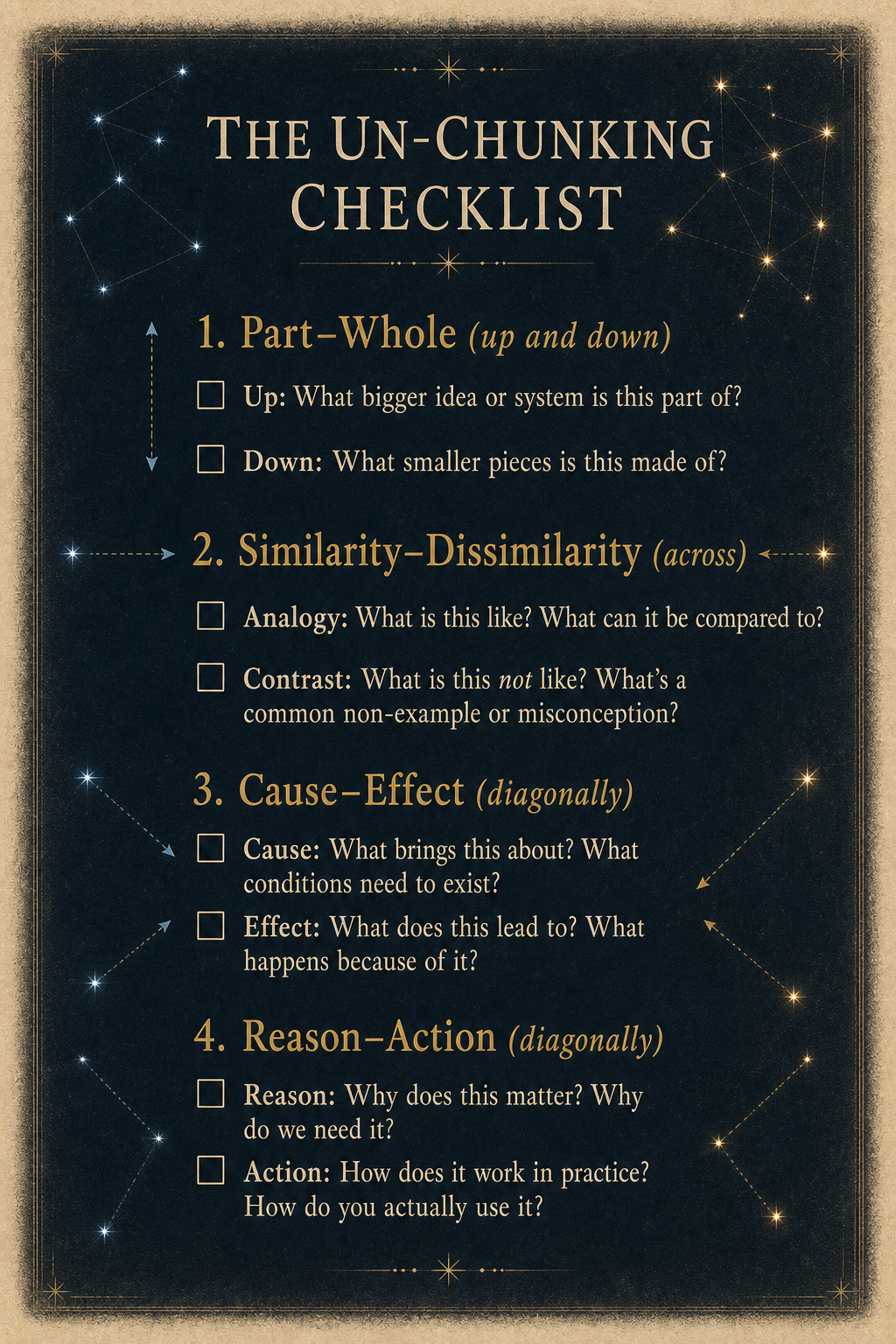
Then use a simple litmus test: can you explain the concept so that a ten-year-old could understand it? If not, you may still be teaching from the finished structure rather than from the learner’s starting point.
Where have you been the blind expert this month?
Here is the useful part: bulldoze your expertise, rebuild it step by step, and your teaching will become clearer for everyone who is still trying to see the path.
References
Allison, S., & Tharby, A. (2015). Making every lesson count: Six principles to support great teaching and learning. Crown House Publishing. https://www.crownhouse.co.uk/making-every-lesson-count-2
Hattie, J., & Yates, G. C. R. (2014). Visible learning and the science of how we learn. Routledge. https://www.routledge.com/Visible-Learning-and-the-Science-of-How-We-Learn/Hattie-Yates/p/book/9780415704991
Koe, D. (2023, March 3). The future of the creator economy (My bold prediction). https://thedankoe.com/letters/the-future-of-the-creator-economy-my-bold-prediction/
National Reading Panel. (2000). Teaching children to read: An evidence-based assessment of the scientific research literature on reading and its implications for reading instruction. National Institute of Child Health and Human Development. https://www.nichd.nih.gov/publications/pubs/nrp/report
Sweller, J. (1988). Cognitive load during problem solving: Effects on learning. Cognitive Science, 12(2), 257–285. https://doi.org/10.1207/s15516709cog1202_4
Waitzkin, J. (2008). The art of learning: An inner journey to optimal performance. Free Press. https://www.simonandschuster.com/books/The-Art-of-Learning/Josh-Waitzkin/9780743277464
Wentzel, A. (2019). Teaching complex ideas: How to translate your expertise into great instruction. Routledge. https://www.routledge.com/link/link/p/book/9781138482371
Same constellation